To remove a stripped or broken bolt without damaging the internal female thread, apply one of these 5 workshop methods based on bolt condition: cut a flat drive slot with a rotary tool if the head protrudes, drive in a Torx bit on rounded Allen sockets, center-drill with a 5% cobalt bit and use a reverse spiral screw extractor (easy-out), MIG-weld a hex nut onto flush-sheared shanks, or apply thermal shock with a torch and penetrating fluid to break seized rust bonds.
src="https://buloneraalvear.online/media/photos/banners/hero_extractor_tornillo_roto.png"
alt="Reverse spiral screw extractor removing a sheared steel bolt from cast iron engine block in workshop"
width="1280"
height="720"
fetchpriority="high"
class="w-full h-auto object-cover rounded-t-xl"
>
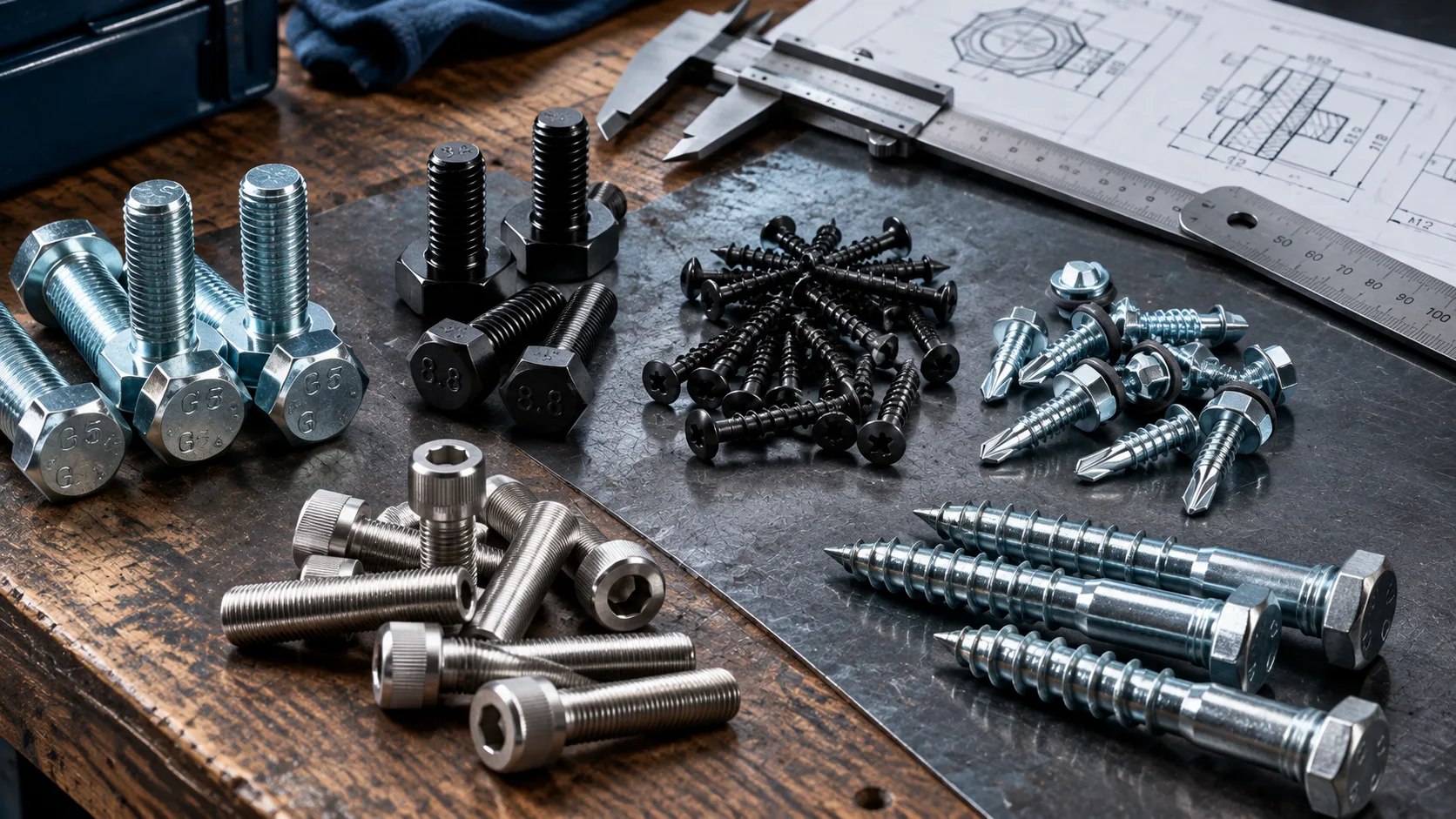
Precision extraction: the reverse spiral fluted bit cuts into the pilot-drilled core to back the broken bolt out counter-clockwise.
Few things cause more frustration in the workshop than the dry snap of a high-tensile bolt shearing off flush with the engine block, or a driver bit spinning freely inside a stripped fastener head. The common knee-jerk reaction is to strike it recklessly with a cold chisel or force cheap HSS drill bits that wander off-center, permanently chewing through the parent casting.
At Bulonera Alvear, we regularly see valuable castings and housings ruined by poor technique and substandard tooling. Below, we break down each professional extraction procedure step-by-step alongside the exact drill-to-extractor sizing chart to save your internal threads.
Decision Matrix: Which Method to Use by Problem Type
| Bolt Condition | Recommended Method | Required Tooling | Risk to Parent Part |
|---|---|---|---|
| Stripped drive socket (Phillips / Allen) | Hammer in Torx bit or cut flat slot | Torx bit + hammer / Dremel cutting disc | Minimal |
| Sheared shank with exposed stub | Weld a nut over the stub | MIG welder / Stick electrode + Hex nut | Low |
| Bolt sheared flush or recessed | Reverse spiral screw extractor | Cobalt drill bit + Spiral extractor bit | Moderate (requires centering) |
| Seized by heavy rust or Loctite threadlocker | Thermal shock + Penetrating fluid | Butane/Propane torch + Penetrant spray | Low |
Method 1: Stripped Drive Socket (The Torx Trick & Slot Cutting)
When the internal hex drive of an Allen bolt or the cross recess of a Phillips screw has completely rounded out, but the head remains intact:
The Torx Bit Trick (for stripped Hex/Allen bolts): Select a Torx star bit slightly larger than the rounded opening (for example, a T30 or T40 bit into a stripped 5 mm Allen socket). Drive it in firmly with a ball-peen hammer. The sharp hardened splines will bite fresh grooves into the steel, allowing you to break it loose with a hand ratchet without slipping.
Cutting a Straight Drive Slot (for round or button heads): Using a thin 1 mm cutoff wheel on an angle grinder or rotary tool (like a Dremel), grind a clean, deep slot straight across the center of the head. Then use a heavy-duty flathead screwdriver with a striking cap or a manual hand impact driver to shock it loose.
To learn more about drive profiles and torque capacities, explore our comprehensive guide on fastener head styles and drive types.
Method 2: Reverse Spiral Screw Extractor ("Easy-Out")
This is the industry standard when a bolt snaps off flush with the surface or down inside a threaded blind hole. It features left-hand tapered spiral flutes that wedge deeper into the bolt core and unscrew it as you turn counter-clockwise:
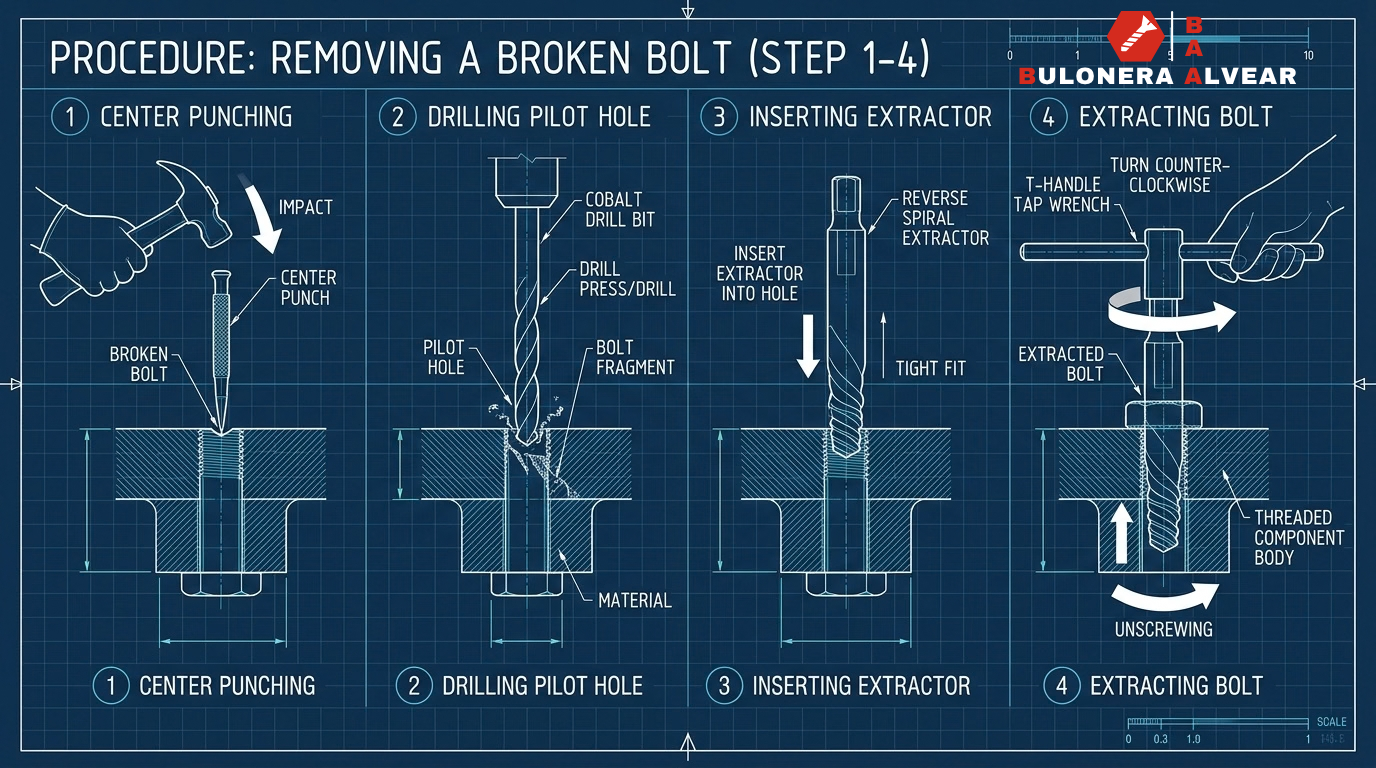
Flatten the Fractured Surface: If the break left jagged, uneven ridges, dress it flat with a file or burr so the drill bit will not skate sideways.
Center Punch (Non-Negotiable Step): Using a hardened steel center punch and a firm hammer blow, dimple the exact geometric dead-center of the broken bolt. Drilling off-center will permanently bore into the female casting threads.
Pilot Drilling with a Cobalt Bit: Medium and high-tensile fasteners (Class 8.8, 10.9, or SAE Grade 8) will instantly burn and dull standard HSS drill bits. Use a 5% Cobalt Alloy bit (HSS-Co / M35) at low RPM with a few drops of cutting fluid or tapping oil.
Engaging the Extractor: Insert the correct extractor into the pilot hole using a manual T-handle tap wrench. Turn it firmly counter-clockwise by hand; as the tapered spirals bite into the steel, the broken shank will break free and back out.
src="https://buloneraalvear.online/media/photos/banners/infografia_pasos_extractor_tornillo.png"
alt="Technical 4-step engineering blueprint diagram for screw extractor operation: center punching, cobalt pilot drilling, insertion, and counter-clockwise removal"
width="1280"
height="720"
loading="lazy"
decoding="async"
class="w-full h-auto object-contain rounded-t-xl"
>
4-step screw extraction blueprint: precise center punching, cobalt pilot drilling, tapered bit insertion, and counter-clockwise extraction.
Sizing Chart: Bolt Size vs. Pilot Drill Bit vs. Extractor Number
| Broken Bolt (Metric) | Broken Bolt (Imperial) | Pilot Bit Diameter | Extractor Size |
|---|---|---|---|
| M4 – M6 | 1/8" – 1/4" | 2.5 mm (3/32") | Extractor #1 |
| M6 – M8 | 1/4" – 5/16" | 3.5 mm (1/8") | Extractor #2 |
| M8 – M11 | 5/16" – 7/16" | 4.5 mm (3/16") | Extractor #3 |
| M11 – M14 | 7/16" – 9/16" | 6.0 mm (1/4") | Extractor #4 |
| M14 – M18 | 9/16" – 3/4" | 8.0 mm (5/16") | Extractor #5 |
Method 3: Welding a Nut (The Master Workshop Technique)
This is by far the most reliable method for medium to large bolts (M8 / 5/16" and up) broken flush inside cast iron engine blocks or heavy structural steel plates:
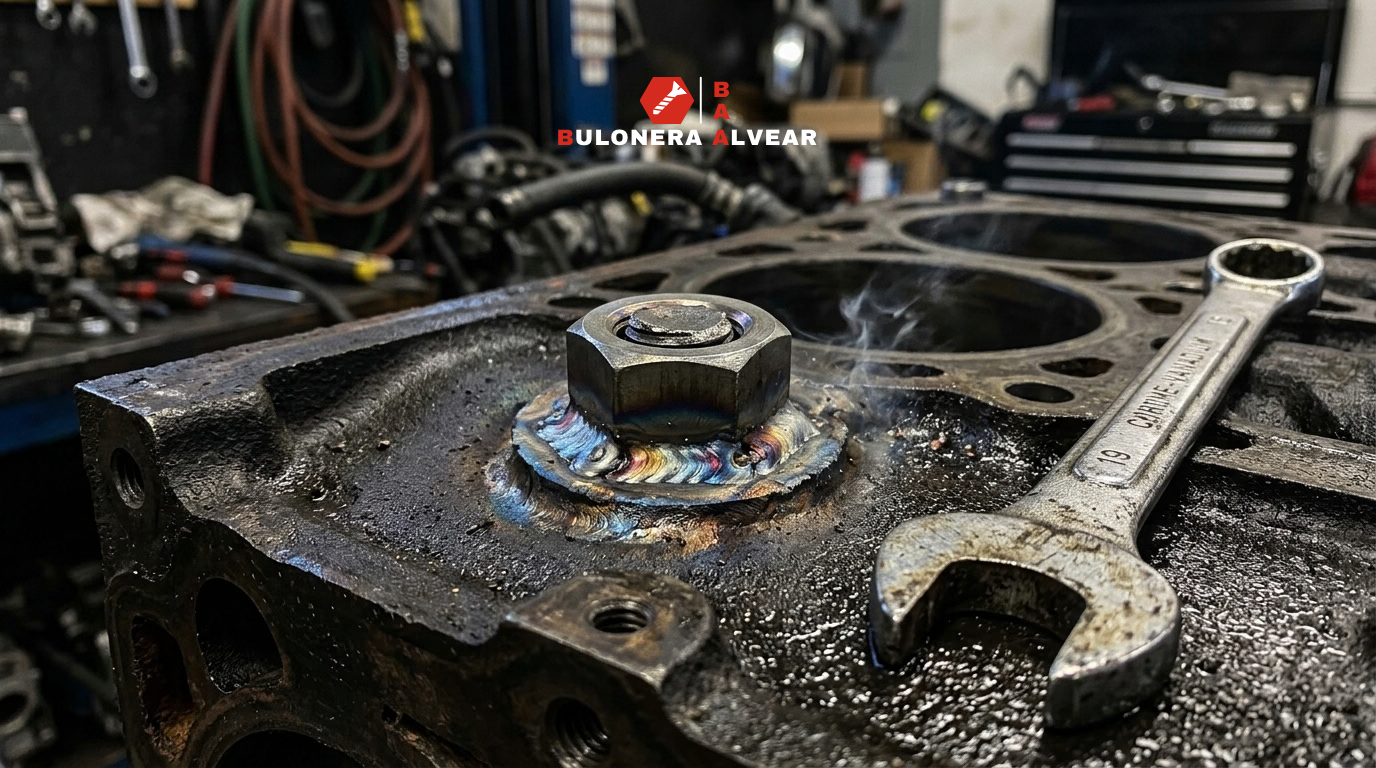
- Place a standard steel hex nut with an inner diameter matching or slightly smaller than the broken bolt stub directly over the fracture.
- Using a MIG welder or stick electrode (such as E7018 or specialized stainless/cast electrode), puddle weld down through the center hole, directly fusing the nut to the core of the broken bolt.
- The intense heat does 80% of the extraction work: Massive localized thermal expansion crushes the rust crust along the thread interface and instantly vaporizes hardened threadlocking compounds.
- Let it cool down for 2 to 3 minutes until the dull cherry red glow subsides, douse it with penetrating oil, and gently unscrew the nut with a box wrench or standard six-point socket.
src="https://buloneraalvear.online/media/photos/banners/soldadura_tuerca_perno_roto.png"
alt="Steel hex nut welded onto sheared bolt core on engine cylinder block with visible heat temper colors and combination wrench"
width="1280"
height="720"
loading="lazy"
decoding="async"
class="w-full h-auto object-cover rounded-t-xl"
>
Thermal shock via welding: extreme localized heat breaks rust bonds and threadlockers, allowing easy removal with a regular wrench.
Methods 4 & 5: Thermal Expansion & Thread Chasing
Method 4: Torch Heating & Impact Shock: In humid subtropical climates, iron oxide expands between thread flanks, seizing fasteners solid. Heat the surrounding housing with a portable butane or MAPP gas torch so the female cavity expands faster than the bolt shank. Apply aerosol penetrant and strike the center punch sharply with a hammer to break structural shear tensions.
Method 5: Thread Tap Cleanup (The Critical Finish): Once the sheared bolt is out, never screw in a replacement fastener immediately. Run a matching thread tap or thread chaser coated with light machine oil through the hole to wipe out metal filings and oxidized scale. Review thread pitches in our guide on mechanical thread standards and pitch verification.
Professional Extraction Tooling & Fastener Supply
Did a bolt just snap in the middle of your workday? At Bulonera Alvear, we stock professional chrome-vanadium reverse spiral extractor sets, high-speed 5% cobalt drill bits engineered for hardened 8.8 and 10.9 fasteners, penetrating sprays, and metric/SAE thread taps. Stop by our trade counter for expert mechanical guidance.
Frequently Asked Questions on Broken Bolts
Why do screw extractors snap off and how can I prevent it?
Screw extractors are made of extremely hard tool steel, making them brittle under sideways bending loads. If you use an undersized extractor, exert crooked rotational force, or drill off-center, the bit will snap inside the bolt core, worsening the extraction. Always keep the T-handle wrench perpendicular and properly aligned with the bolt axis.
Can I use a standard hardware store HSS bit to drill a broken 8.8 bolt?
No. Standard high-speed steel (HSS) drill bits have roughly the same hardness rating as a heat-treated fastener (Class 8.8, 10.9, or Grade 5), and will lose their cutting edge in seconds due to friction heat. Always use 5% Cobalt alloy bits (HSS-Co / M35) at low rotational speeds with abundant cutting lubricant.
How do you loosen a bolt seized with red high-strength threadlocker?
High-strength anaerobic threadlockers require localized heating to break down the polymer chains. Heat the joint with an industrial heat gun or gas torch to over 200 °C (390 °F) for 60 to 90 seconds; the adhesive will disintegrate into a harmless powder, allowing the bolt to turn with normal hand wrench torque.