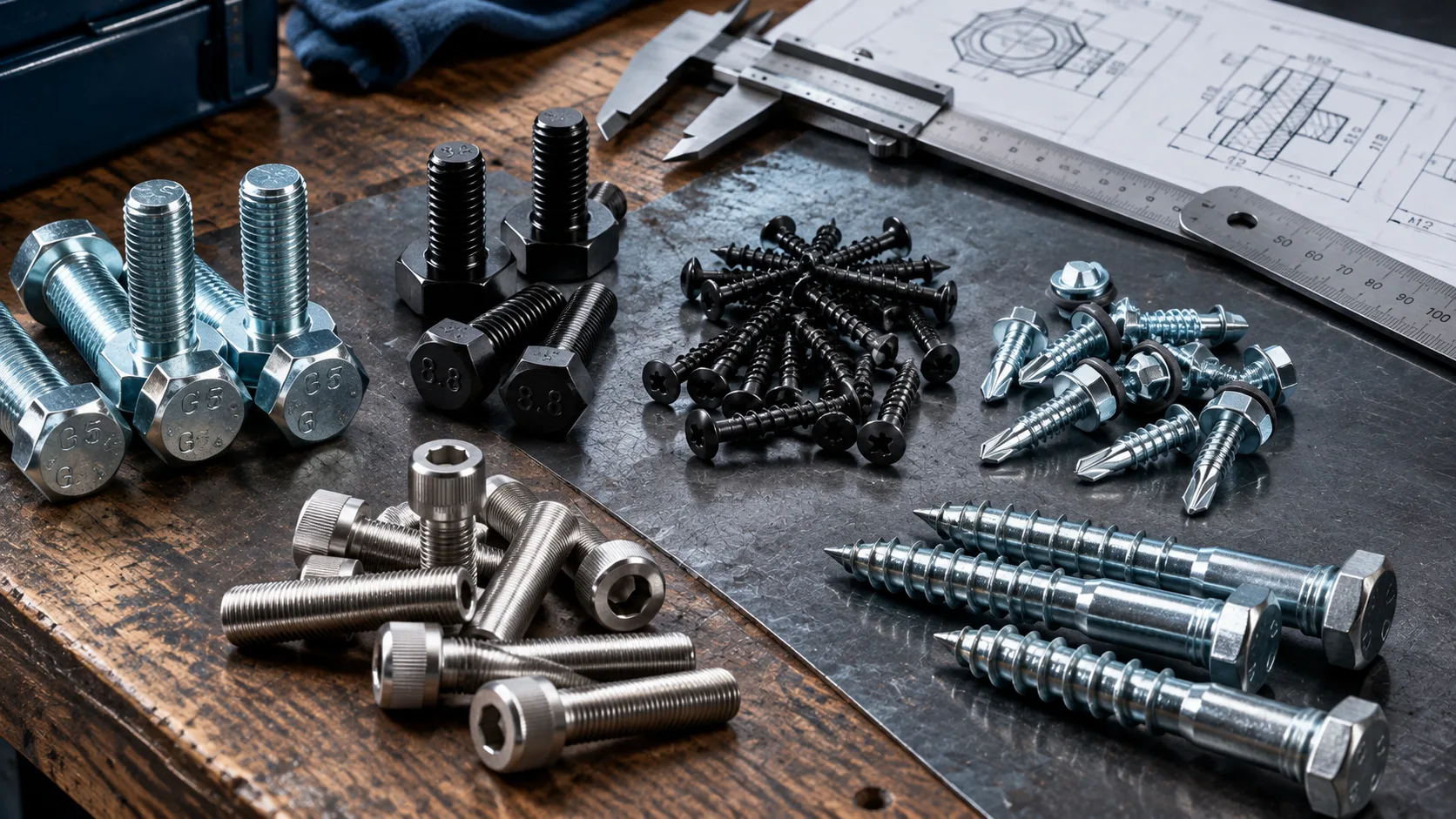
Accurate identification of mechanical fasteners requires verifying three critical parameters: major outside diameter, thread pitch, and flank angle (60° for Metric ISO/Unified threads versus 55° for Whitworth and BSP pipe threads). Forcing an incompatible bolt into a nut causes thread galling, binding, and structural joint failure.
Throughout nearly 40 years of service at Bulonera Alvear, our counter staff and field technicians have encountered the exact same issue thousands of times: the dreaded sudden seize when a bolt jams halfway into its hole. It is rarely caused by dirt or insufficient tightening; in almost all cases, the root cause is a standards mismatch between the fastener and the mating component.
1. Technical Anatomy of a Screw Thread
A screw thread is a continuous uniform helical ridge formed on the outer or inner surface of a cylinder or cone, engineered to transmit motion or maintain a preload clamp. In the workshop, three key dimensions define any thread profile:
- Pitch: The axial distance between adjacent thread crests. In the metric system, it is measured directly in millimeters; in imperial and unified systems, it is designated as Threads Per Inch (TPI).
- Flank Angle: The angle between adjacent thread flanks. Standard modern industrial threads use a 60° angle, whereas traditional British Whitworth profiles feature a 55° angle.
- Major (Nominal) Diameter: The maximum diameter measured across the external crests of a bolt or screw.
2. The 3 Dominant Fastener Systems in Industrial Maintenance
In manufacturing, heavy machinery, and automotive environments, three incompatible systems coexist. Mixing them leads to stripped internal threads in engine blocks, gearboxes, and structural assemblies.
A. ISO Metric Thread (The Global Standard)
Governed by ISO 68-1 and ISO 261, this is the prevailing worldwide standard found on modern European and Asian vehicles, modern agricultural equipment, and industrial machinery. Identified by the letter M (e.g., M8 × 1.25).
- Flank angle: 60°.
- Pitch configurations: Coarse pitch for general engineering applications, and fine pitch for precision adjustments and assemblies requiring resistance to light vibration.
B. Unified National Thread (UNC / UNF)
Governed by ASME/ANSI B1.1, featuring a 60° symmetrical flank angle with fractional inch nominal dimensions:
- UNC (Unified Coarse): Coarse pitch for rapid assembly and threading into softer base materials such as aluminum or cast iron.
- UNF (Unified Fine): Higher thread density per inch. Provides a larger tensile stress area and significantly superior resistance to vibration-induced loosening in high-stress automotive, driveline, and aerospace assemblies.
C. British Standard Whitworth (BSW / BSF)
Standardized under BS 84 with rounded crests and roots. While superseded in new designs, it remains widely utilized in railway equipment, naval vessels, and vintage British machinery:
- Flank angle: 55°. This 5-degree discrepancy prevents the flanks from seating cleanly inside a metric or UNC nut, causing severe cross-threading and seizing within 2 to 3 turns.
Mechanical Thread Comparison Matrix
| Thread System | Flank Angle | Pitch Unit | Base Standard | Typical Application |
|---|---|---|---|---|
| ISO Metric (Coarse / Fine) | 60° | Millimeters (crest to crest) | ISO 68-1 / ISO 261 | Modern automotive, manufacturing, equipment |
| Unified UNC (Coarse Pitch) | 60° | Threads Per Inch (TPI) | ASME/ANSI B1.1 | Structural steel, US agricultural & earthmoving machinery |
| Unified UNF (Fine Pitch) | 60° | Threads Per Inch (TPI) | ASME/ANSI B1.1 | High-vibration assemblies, drivelines, aerospace |
| Whitworth BSW / BSF | 55° | Threads Per Inch (TPI) | BS 84 | Marine engineering, railways, legacy industrial plants |
| NPT Pipe Thread (Tapered) | 60° | Threads Per Inch (TPI) | ASME B1.20.1 | Oil, gas, chemical processing, American hydraulics |
| BSP Pipe Thread (G / R) | 55° | Threads Per Inch (TPI) | ISO 7-1 / ISO 228-1 | Industrial pneumatics, hydraulics, water & steam lines |
3. Pipe Sealing Threads: NPT vs. BSP
In pneumatic, fluid handling, and hydraulic systems, sealing depends strictly on flank conformation:
- NPT (National Pipe Taper): American tapered pipe thread with a 1:16 taper ratio and a 60° flank angle. Seal is achieved via flank-to-flank interference fit during tightening.
- BSP (British Standard Pipe): Traditional 55° profile. Available as BSPP (parallel/cylindrical, ISO 228-1, "G" prefix) which requires a sealing washer, or BSPT (tapered, ISO 7-1, "R" prefix) which seals on the thread taper.
Shop warning: Never cross an NPT fitting into a BSP port. Although both 1/2" variants carry 14 threads per inch, the 60° vs. 55° angular conflict prevents full engagement and creates pressurized leak paths.
4. Step-by-Step Thread Identification ("The Pitch Gauge Test")
Avoid guesswork on the shop floor. Follow this reliable metrology workflow:
- Measure Major Diameter: Using a vernier or digital caliper, record the crest-to-crest diameter of the bolt. Compare against metric standard tables and fractional inch charts.
- Apply Thread Pitch Gauge: Place gauge leaves along the bolt threads against a light source. The correct leaf must mesh seamlessly with zero light passing through the flanks.
- Confirm Flank Angle: If a metric gauge blade rocks or does not fit flush, test with 55° Whitworth/BSP or 60° Unified imperial blades.

Mating Nut Quality and Performance
Pairing a high-strength bolt with an inferior or incompatible nut (nylon lock nut, acorn nut, or castle nut) leads to preload relaxation and joint failure under operational dynamic loads.
Technical Guidance & Fastener Availability
At Bulonera Alvear, we maintain extensive counter availability of Metric, UNC, UNF, and Whitworth fasteners, with specific batch sizes and special alloys confirmed upon request. Bring your sample piece to our technical counter for verification with metrological workshop tooling.
📍 Av. Alvear 1301, Resistencia, Chaco, Argentina. Regional logistics network and coordinated shipping options nationwide.
Frequently Asked Workshop Questions
Can I thread a Whitworth bolt into a Metric nut of similar diameter?
No. ISO Metric threads feature a 60° flank angle while Whitworth uses 55°. Because contact is limited to pinpoint edges rather than full surface bearing, applying torque causes immediate thread yielding and seizure.
Why are fine threads (UNF) preferred in automotive assemblies?
UNF threads have a smaller lead angle and a larger minor diameter, providing superior tensile strength and significantly higher resistance to vibrational self-loosening under cyclic operational loads.
Why are NPT and BSP pipe fittings non-interchangeable?
NPT uses a 60° flank angle with a 1:16 taper to seal via thread crush, whereas BSP relies on a 55° British geometry. Mismatched threads prevent full engagement, damaging female ports and causing leaks.
Bulonera Alvear — Building the future, bolt by bolt!