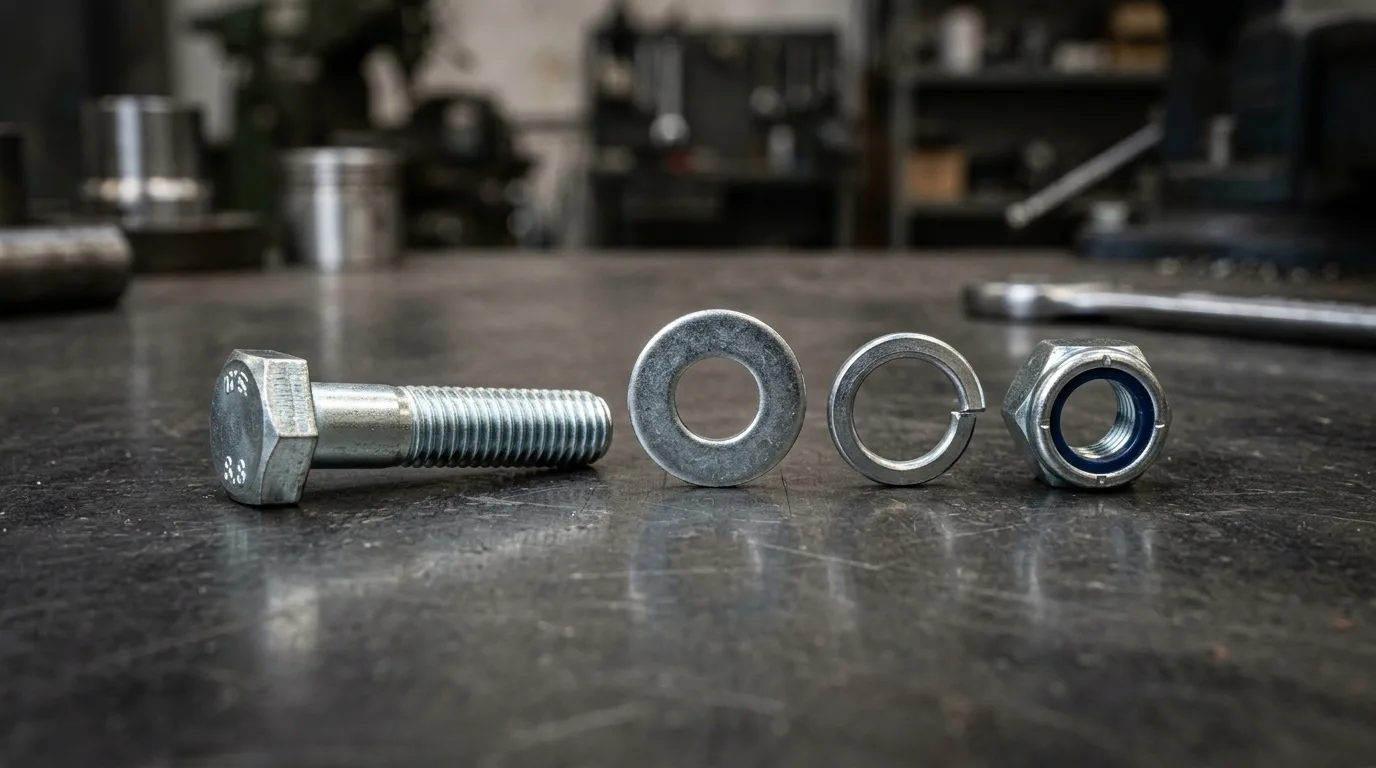
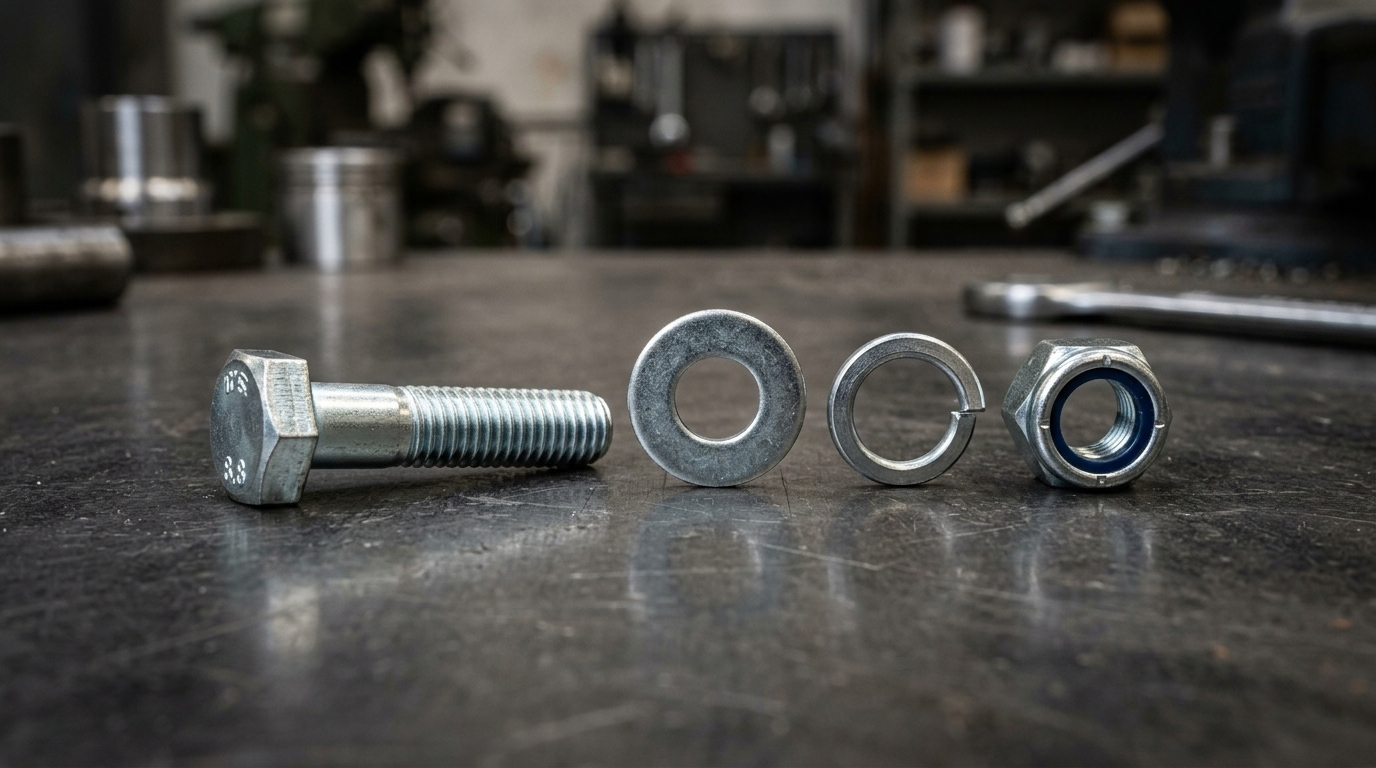
Nuts and washers are critical structural components that determine whether a bolted joint maintains clamping preload or fails under vibration. A flat washer distributes bearing stress and protects parent materials; a helical spring lock washer (Grower) provides auxiliary spring tension; and a nylon insert locknut (nyloc) prevents rotational loosening under continuous mechanical shock and dynamic loads.
1. Types of Washers and Their Engineering Purpose
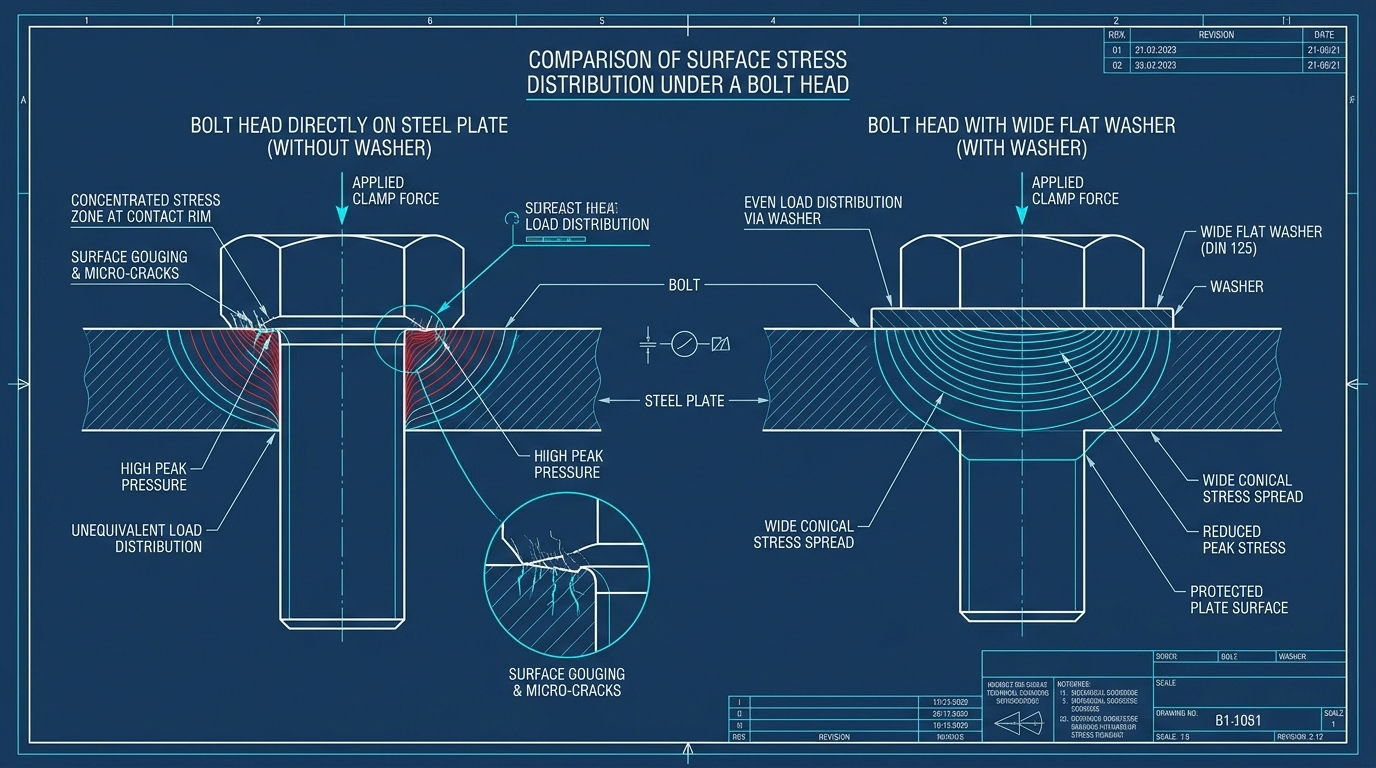
- Standard Flat Washer (DIN 125 / ISO 7089): Increases contact surface area beneath the bolt head or nut. Prevents surface gouging, stress concentration, and stabilizes torque-to-tension friction.
- Wide Fender Washer (DIN 9021): Outer diameter roughly 3x the bolt nominal diameter. Essential for sheet metal, wood, fiberglass, or oversized holes to prevent pull-through.
- Split Spring Lock Washer / Grower (DIN 127): Hardened split helical ring. When torqued flat, it stores elastic energy to absorb initial settling and joint relaxation in light vibrating machinery.
- Belleville Conical Washers (DIN 6796): Heavy-duty conical spring washers engineered to maintain high clamping forces across wide thermal expansion cycles (exhaust systems, steam flanges).
2. Nut Selection and the Grade Matching Rule
The nut must match or exceed the proof strength of the mating bolt. Pairing a soft mild-steel nut with a Grade 8.8 or Grade 5 bolt will strip internal nut threads before reaching proper torque.
- Standard Hex Nut (DIN 934 / ISO 4032): Universal fastener. Requires auxiliary locking devices in high-vibration environments.
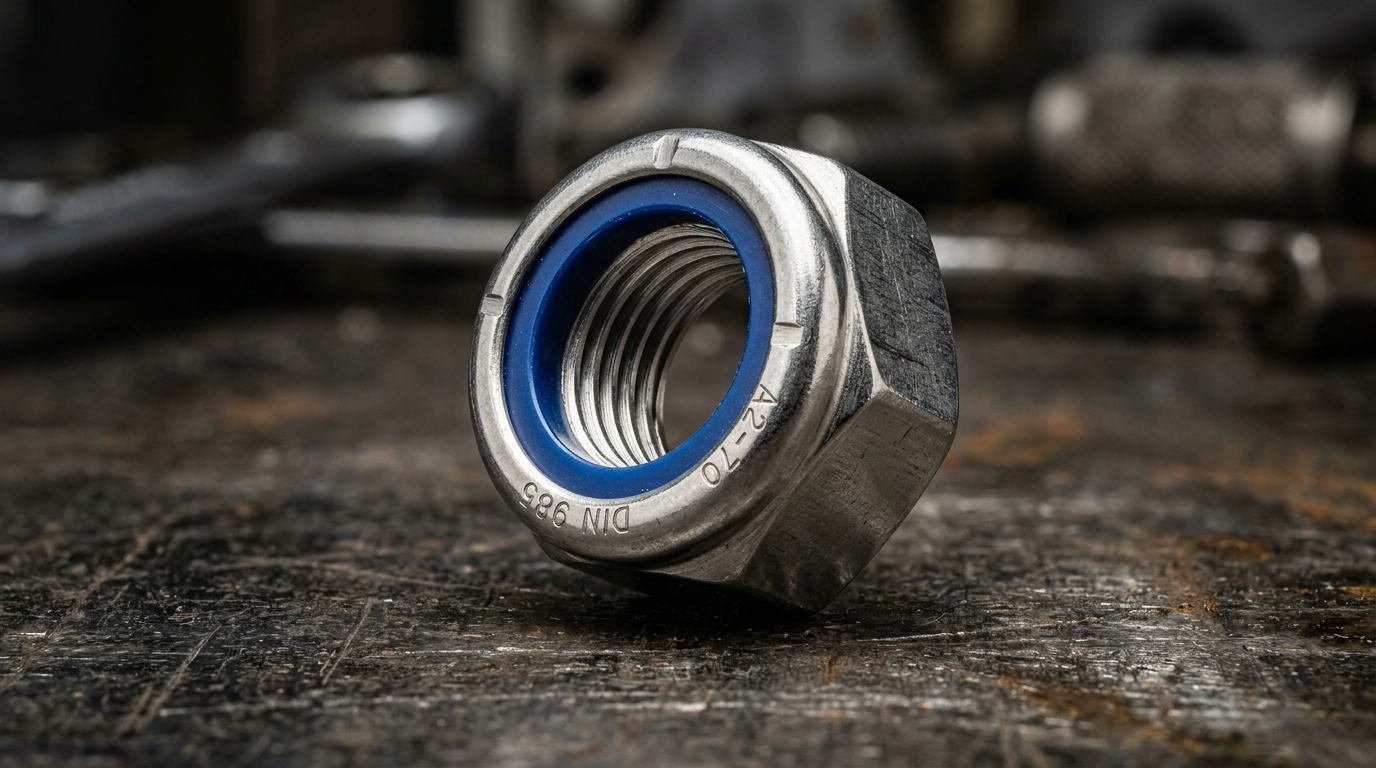
- Nylon Insert Locknut / Nyloc (DIN 985): Features a self-locking nylon collar that grips bolt threads radially. Working temperature limit: ~120 °C (250 °F).
- All-Metal Locknut (DIN 980): Distorted-thread all-steel nut capable of handling temperatures up to 300 °C without plastic components.
- Slotted / Castle Nut (DIN 935): Positively locked using a cotter pin through a drilled bolt hole. Essential for trailer hubs, wheel spindles, and steering linkages.
Fastener Selection Guide: Nuts and Washers
| Hardware Type | Standard | Mechanical Function | Typical Application |
|---|---|---|---|
| Flat Washer | DIN 125 | Load spreading, surface protection | General structural bolting |
| Split Lock Washer | DIN 127 | Spring preload retention | Electric motors, pumps |
| Fender Washer | DIN 9021 | Oversized hole spanning, soft sheet clamping | Sheds, trailers, timber joints |
| Nylon Locknut | DIN 985 | Prevents rotational backing-off | Agricultural equipment, trailers |
| Castle Nut | DIN 935 | Positive cotter pin locking | Wheel hubs, steering linkages |
Correct Assembly Stacking Order
- Place a flat washer beneath the bolt head if clamping onto soft or thin materials.
- Insert the bolt through the workpieces to be joined.
- On the nut side, stack the flat washer directly against the workpiece face.
- Stack the spring lock washer (Grower) on top of the flat washer.
- Thread and tighten the nut to specified torque. Never seat a split lock washer directly against soft base metals like aluminum.
Why this sequence? Seating a split lock washer directly against soft steel or aluminum gouges the surface during tightening, destroying the parent material and causing immediate preload loss. The flat washer acts as a protective bearing shield.
Industrial Fasteners & Hardware at Bulonera Alvear
Bulonera Alvear stocks an exhaustive inventory of metric and imperial nuts, heavy-duty washers, locknuts, and AISI 304 Stainless Steel hardware for industrial machinery and construction projects. Available by piece or in bulk boxes with certified quality and corporate invoicing.
Frequently Asked Questions
Can a nylon insert locknut be reused?
Not in safety-critical assemblies. The mating bolt threads permanently cut and deform the nylon collar during initial installation. Reusing the nut reduces prevailing-off torque by more than 50%, compromising locking reliability.
Why did the nut threads strip during torquing?
This occurs when the property class of the nut is lower than the bolt. For example, pairing a low-carbon mild steel nut with an 8.8 grade bolt causes the nut threads to strip before reaching nominal clamping torque.
Do I need a split lock washer if I am using a locknut?
No, this is completely redundant. The DIN 985 locknut provides positive rotational locking directly on the thread. A spring washer adds no value and can reduce contact consistency; use only a flat washer to protect the workpiece.