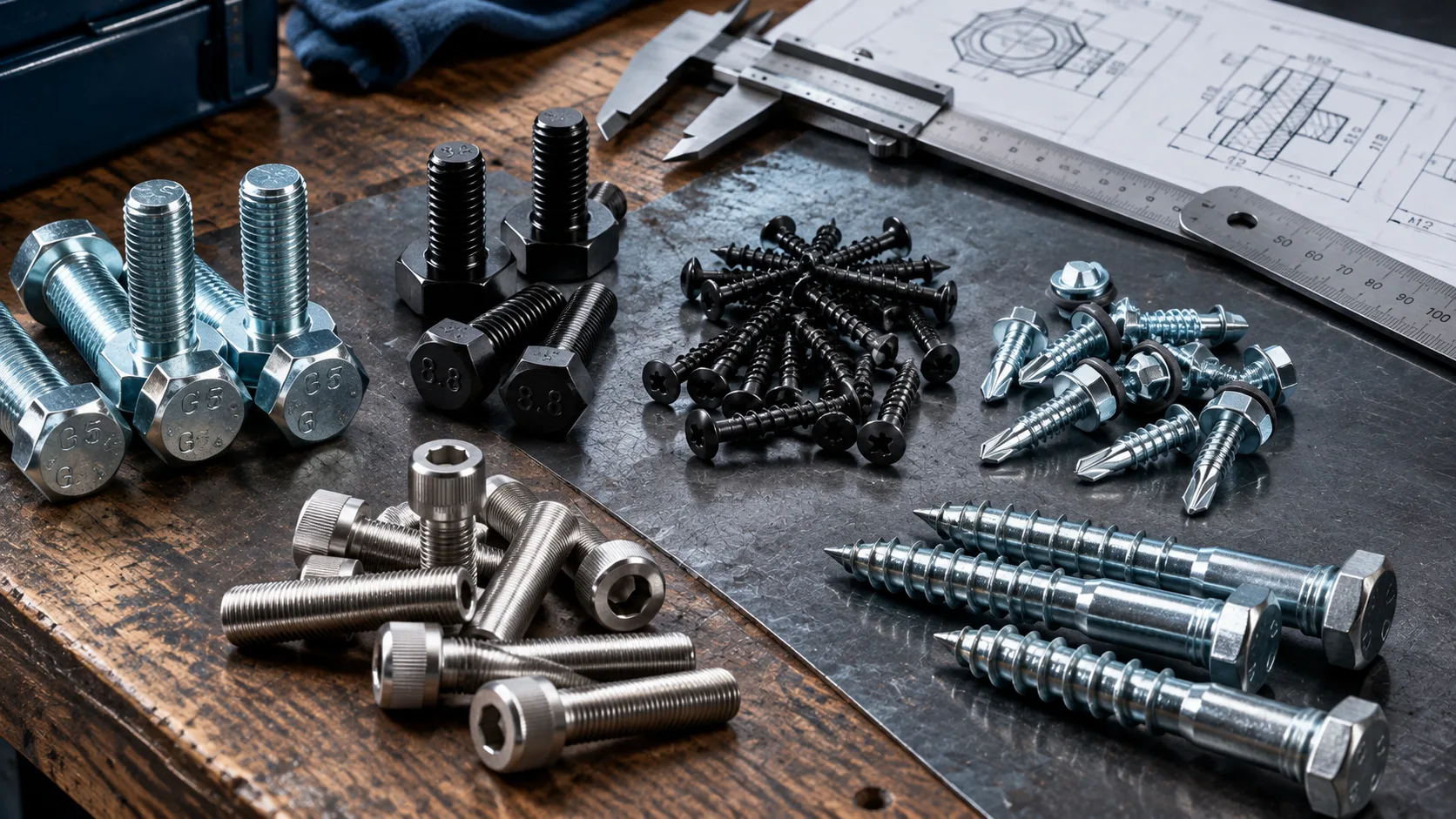
Selecting the correct screw requires evaluating four critical mechanical variables: the base substrate (wood, sheet metal, masonry, or structural concrete), the expected load profile (axial tension, shear forces, or dynamic vibration), the drive recess required for proper installation torque, and the protective finish tailored to environmental exposure.
Browsing through a hardware warehouse shelf filled with thousands of fastener variants without a clear specification is a common dilemma. Installing the wrong fastener compromises joint integrity: threads strip under torque, shear loads snap shanks, or excessive expansion wedges crack the substrate.
In this technical pillar guide from Bulonera Alvear, we establish a standardized engineering taxonomy for mechanical screws, cross-linking specialized applications with our in-depth component guides.
The Fastener Map: Specialized Engineering Series
To master fastener selection and prevent structural errors on the job site, we have divided the hardware landscape into 6 dedicated technical modules:
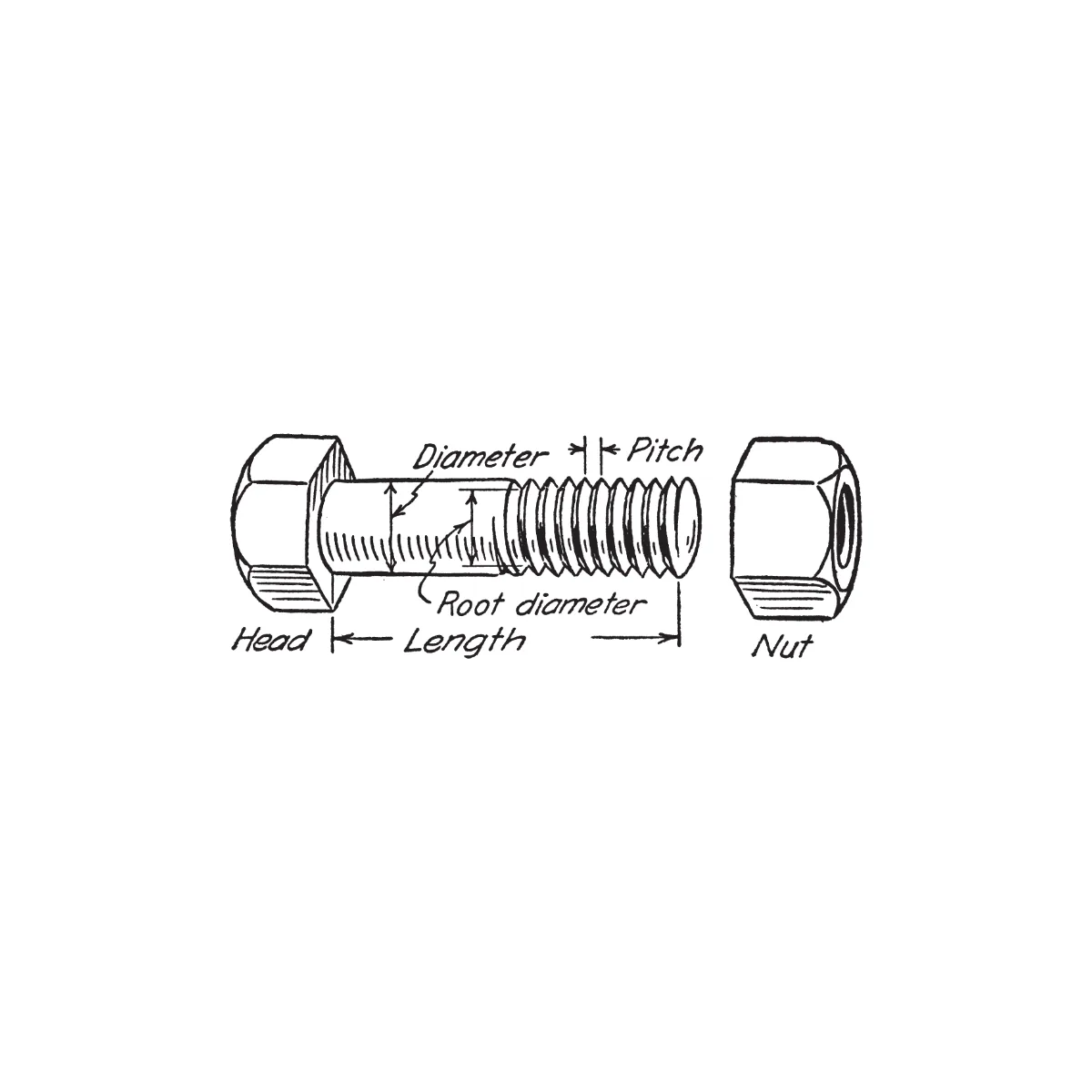
1. Screw Anatomy: Mechanical Parts and Functions
What is the difference between pitch, crest, and root? Why does an unthreaded smooth shank prevent wood framing members from separating during clamping? Explore the mechanics of threaded joints.
👉 Read the Screw Anatomy Guide2. Classification by Head Style and Drive Types
Head configuration dictates permissible seating torque, joint aesthetics, and required tooling: from heavy-duty hex heads to cam-out resistant Torx drives and low-profile wafer heads.
👉 Read the Head Styles & Drives Guide3. Classification by Thread Profile and Pitch
Threads are the prime mechanism for developing joint clamp load. Learn to distinguish between ISO Metric pitches, Unified inch standards (UNC/UNF), and coarse wood threads to prevent stripping.
👉 Read the Thread Types Guide4. Classification by Materials and Corrosion Protection
Electro-galvanized zinc, hot-dip galvanizing, or austenitic stainless steel grades A2/A4. Prevent galvanic corrosion and premature failure under high humidity and outdoor conditions.
👉 Read the Materials and Coatings Guide5. Classification by Substrate and Installation Context
Engineered fasteners for timber and MDF, self-drilling TEK screws for structural steel framing, mechanical nylon expansion anchors, and heavy-duty chemical anchoring systems.
👉 Read the Screws by Application Guide6. Strength Grades and Head Markings Interpretation
Deciphering "8.8", "10.9", or "12.9" numerical stamping under ISO 898-1 and radial head lines for SAE J429 Grade 5 and Grade 8 to calculate tensile proof loads and shear capacity.
👉 Read the Fastener Strength Grades GuideFastener Selection Matrix: Quick Reference Guide
| Fastener Type | Substrate | Thread Pitch / Point | Standard Drive | Typical Finish |
|---|---|---|---|---|
| Hex Head Lag Screw | Solid timber, masonry w/plug | Coarse pitch, gimlet point | External hex | Clear zinc / hot-dip galvanized |
| Self-Drilling TEK Screw | Steel purlins, tubing, sheet metal | Drill point DIN 7504 | Hex washer or Wafer head | Electro-zinc / Ruspert coating |
| Drywall Screw | Gypsum board to light-gauge studs | Fine thread / sharp twinfast | Countersunk Bugle Phillips #2 | Black phosphate |
| Chipboard / Wood Screw | MDF, particleboard, cabinetry | Sharp deep single thread | Flat countersunk Pozidriv / Torx | Yellow zinc dichromate |
| Structural Hex Bolt & Nut | Through-bolted metal connections | ISO Metric / UNC / UNF | External hex for sockets/wrenches | Black oxide, zinc, Stainless A2/A4 |
5 Critical Workshop Pitfalls (and How to Avoid Them)
1. Self-Drilling Screws vs. Heavy-Duty Lag Screws
- Self-Drilling Screw: Features an integrated drill bit tip. It drills, taps, and fastens structural steel in a single continuous drive operation.
- Lag Screw: Features a solid tapered gimlet point. Requires a pre-drilled pilot hole (particularly in hardwoods) or installation into an expansion wall plug.
- Consequence of confusion: A drill-point screw in timber pulverizes wood grain without achieving clamping friction; while a lag screw driven into steel without a pilot hole burns tool bits and strips heads.
2. Wood Screws vs. Sheet Metal Screws
The distinction lies in thread pitch geometry. Wood screws feature coarse, wide-spaced threads engineered to grip fibrous grain. Sheet metal screws require low-profile, closely-spaced threads (fine pitch) to maximize mechanical engagement along thin steel walls.
3. Electro-Zinc Plating vs. Austenitic Stainless Steel
Zinc-plated fasteners carry a micro-thin sacrificial zinc layer over carbon steel, designated strictly for dry, climate-controlled interiors. Stainless steel (AISI 304/A2 or AISI 316/A4) incorporates chromium and nickel throughout its metallurgical alloy, delivering long-term atmospheric corrosion resistance.
4. Through-Bolts vs. Blind Expansion Anchors
Through-bolts require a full through-hole and bilateral access to torque the nut against washers. Mechanical or chemical anchors operate via single-sided access, securing directly into blind holes in solid masonry or concrete foundations.
5. Hex Head vs. Phillips Drive Under High Torque
Hex heads permit high seating torques using sockets or box wrenches without rounding corners. Phillips cross recesses are intended for light assembly and will cam out when exceeding friction thresholds, permanently damaging the screw recess.
5-Step Sequential Selection Methodology
- Base substrate: Wood (lag screw or chipboard screw), steel framing (self-drilling TEK screw sized to steel gauge), drywall (phosphate bugle screw), or solid concrete (mechanical wedge anchor or chemical rod).
- Exposure environment: Indoor dry (zinc/yellow dichromate), exterior exposed (hot-dip galvanized or A2 stainless), marine/chemical industrial (A4 stainless with molybdenum).
- Mechanical load category: Light architectural fastening (commercial grades), moderate structural assemblies (Grade 5.8 / 8.8), high-stress framing or heavy machinery (Class 8.8, 10.9, or SAE Grade 8).
- Assembly accessibility: Both sides accessible (through-bolt with nut and washers) or blind single-sided installation (self-tapping screw or expansion anchor).
- Head profile requirement: Flush installation (countersunk flat head), wide surface clamping (wafer or bonded washer head), or maximum wrenching torque (external hex head).
Technical Guidance on Industrial Fasteners
At Bulonera Alvear, we stock an extensive counter inventory of self-drilling fasteners, heavy-duty lag screws, high-tensile structural bolts, and anchor systems, with specific alloy availability confirmed based on project engineering specifications.
📍 Av. Alvear 1301, Resistencia, Chaco, Argentina. Regional logistics network and coordinated domestic freight options.
Frequently Asked Questions: Fastener Selection
What is the engineering difference between a screw and a bolt?
A screw engages directly into an internal threaded hole or taps its own mating thread during installation. A bolt is a precision machine fastener that passes entirely through clearance holes and secures using a nut on the opposite side.
Can ISO Metric and Imperial Unified threads be coupled together?
No. Even when nominal diameters appear interchangeable (e.g., M8 and 5/16"), thread pitch and flank profiles differ. Cross-threading forces severe thread stripping and compromises assembly proof load.
Which fastener is specified for metal roofing sheets on structural steel purlins?
Specify a hex-head self-drilling screw fitted with a bonded EPDM/steel vulcanized sealing washer, selecting a drill-point capacity that matches purlin thickness to ensure leak-free hydraulic performance.
Bulonera Alvear — Building the future, bolt by bolt!